.svg)
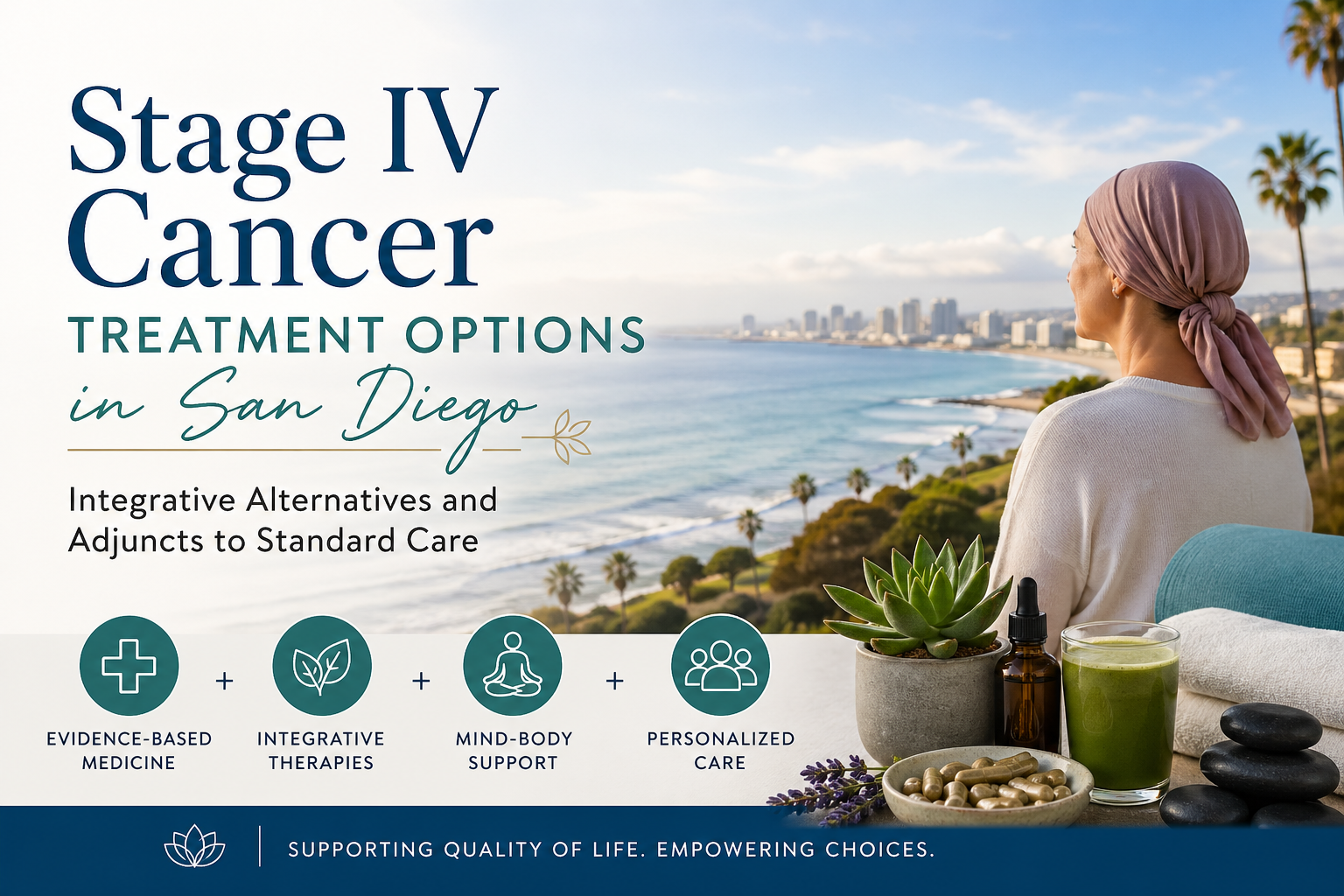
A stage IV cancer diagnosis changes everything. The conversation shifts from cure to control, from short timelines to long ones, from "what's the standard treatment?" to "what else is possible?"
For patients in San Diego County navigating this, the answer often involves looking beyond the conventional system. Not in opposition to it — but in addition to it. Integrative cancer care offers a set of tools that, used alongside standard oncology, can support quality of life, address the biological terrain that allows advanced disease to progress, and give patients meaningful agency in their own care.
This article walks through the integrative options available at Quantum Functional Medicine in Carlsbad for patients with stage IV diagnoses, what to consider when evaluating them, and how to think about combining them with conventional treatment.
What "Stage IV" Actually Means for Treatment Planning
Stage IV — sometimes written as stage 4 — is the designation given when a cancer has spread from its original site to distant organs or tissues. The mechanics differ by cancer type, but the implication is consistent: the disease is no longer localized.
Conventional oncology approaches stage IV cancer with a different goal than earlier stages. Where earlier stages aim for cure, stage IV protocols typically aim for control — slowing progression, managing symptoms, and extending life with the best possible quality.
This is where integrative care becomes especially relevant. Many of the tools used in integrative oncology are well-suited to a control-and-support model: they can be used alongside conventional treatment, sustained over long periods, and adjusted as the situation evolves.
Integrative Treatment Options for Stage IV Cancer
At Quantum Functional Medicine in Carlsbad, the integrative protocols most commonly used in stage IV cases include:
FCBRM (Fractionated Chemotherapy with a Bio-Response Modifier)
FCBRM uses insulin to enhance the cancer cell uptake of chemotherapy, allowing for meaningfully lower doses than conventional protocols. For stage IV patients, the appeal is the combination of targeted action with reduced toxicity — making sustained, long-term treatment more tolerable.
Photodynamic Therapy (PDT)
PDT uses light-activated agents that target cancer cells while sparing healthy tissue. It is one of several precision modalities that can be incorporated into a stage IV plan.
Mistletoe and Helleborus Therapy
Mistletoe therapy has been used in European integrative oncology for decades, particularly in advanced disease. It is most commonly used to support immune function and quality of life during conventional treatment.
Oxidative Therapies
Ozone therapy, hydrogen peroxide infusions, and high-dose vitamin C alter the cancer environment in ways that may complement other treatments. They are also used to support energy and immune function.
Peptide Therapies
Specific peptides can be used to support immune signaling, tissue repair, and overall resilience during long-arc treatment.
Repurposed Medications
Established medications originally developed for non-cancer uses have been studied for anti-cancer activity. Where appropriate, these can be incorporated into the protocol.
Metabolic Cancer-Blocking Agents
The metabolic terrain that supports cancer growth — glucose metabolism, mitochondrial function, inflammation — can be targeted with specific interventions designed to make the body a less hospitable environment for the disease.
RGCC Blood Testing
For stage IV patients, RGCC testing — particularly chemosensitivity and natural-substance sensitivity panels — can dramatically change the design of the treatment protocol. It provides a personalized roadmap of which agents the patient's specific cancer cells respond to.
Nutritional and IV Nutrient Support
Sustained, well-designed nutritional support is one of the highest-impact interventions in advanced cancer care. It addresses deficiencies, supports immune function, and provides the building blocks for resilience through long treatment courses.
The plan for any specific patient is built from these tools — not all of them, and not in isolation. The clinical team selects the combination most relevant to the patient's diagnosis, prior treatment history, current health status, and goals.
Coordinating With Your Conventional Oncology Team
For stage IV patients, the integrative-and-conventional question becomes especially important. Conventional treatment for advanced disease often involves chemotherapy, targeted therapy, immunotherapy, or radiation — sometimes in combination, sometimes in sequence.
Integrative protocols can be designed to:
- Run alongside conventional treatment — supporting the patient through the side effects and addressing the biological terrain at the same time
- Bridge between conventional treatment cycles — using the time between rounds to rebuild and address the broader picture
- Continue after conventional options have been exhausted — providing tools that can extend quality of life and support the body
Open communication with the oncology team is the standard. Patients are encouraged to keep their full medical team informed about every supportive therapy.
Questions to Ask When Evaluating Stage IV Treatment Options
If you're a stage IV patient or family member considering integrative options in Carlsbad or the broader San Diego area, useful questions to bring to a consultation include:
- What integrative tools are most relevant to my specific cancer type and stage?
- How do these tools coordinate with the conventional treatment I'm receiving (or considering)?
- What does the realistic timeline and protocol look like?
- What costs should I expect, and what is and isn't covered by insurance?
- What does monitoring look like — how do we know if it's working?
- What does the team's experience look like with cases similar to mine?
- What happens if my situation changes — how does the protocol adjust?
A good clinical team will welcome these questions and answer them directly.
Quality of Life as a Treatment Goal
One of the most under-discussed aspects of stage IV cancer care is the emphasis — or lack of it — on quality of life. Conventional treatment plans often default to maximum-tolerated-dose protocols that prioritize tumor response above all else. For some patients in some situations, that's the right call. For others, it isn't.
Integrative care frames quality of life as a treatment goal in its own right. Not a consolation prize for when conventional treatment runs out — but a metric that shapes every decision from the start.
For Carlsbad and North County San Diego patients, this often translates to:
- More energy through treatment
- Better sleep, appetite, and digestive function
- Less downtime between cycles
- Ability to remain present and active for family, work, and life
- A clearer sense of agency in their own care
These outcomes don't happen by accident. They're built into the protocol from day one.
Frequently Asked Questions About Stage IV Cancer Treatment in San Diego
Can integrative cancer care actually help stage IV patients?
Integrative care can support quality of life, complement conventional treatment, and address the broader biological terrain. It is not a guaranteed cure, and outcomes depend on the patient's specific situation. The realistic goal is to use every reasonable tool to support the best possible quality and length of life.
Is integrative care a replacement for conventional treatment in stage IV cases?
No. Most stage IV patients use integrative care alongside or in coordination with conventional treatment. The clinical team will discuss the best sequencing and combination for each individual case.
What if my oncologist isn't supportive of integrative care?
This is not uncommon. Many integrative practitioners are willing to coordinate directly with oncology teams when the oncologist is open to it. When the oncologist is not, patients can still pursue integrative care — but communication between teams becomes the patient's responsibility.
How quickly can I be seen for a consultation?
Consultation availability varies. Stage IV cases are generally prioritized given the time-sensitive nature of treatment decisions. Contact our Carlsbad clinic directly to discuss timing.
What records should I bring to a first consultation?
Recent imaging, pathology reports, treatment history, current medication and supplement lists, and recent labs from your oncology team. The more complete the picture, the more useful the first conversation.
Do you accept patients from outside San Diego County?
Yes. Patients regularly travel to our Carlsbad clinic from across Southern California and out of state for treatment series. We can discuss logistics during your initial consultation.
Will integrative care help if conventional treatment has stopped working?
Many patients pursue integrative care after conventional options have been exhausted. While no specific outcome is promised, the integrative toolkit offers options for continued treatment, quality-of-life support, and long-term care.
Starting the Conversation
If you or a loved one is navigating a stage IV diagnosis in San Diego County, the most useful next step is a consultation. Our team will review your records, discuss your goals, and walk through what an integrative protocol could look like for your specific situation.
Schedule a consultation with Quantum Functional Medicine
This article is for educational purposes only and does not constitute medical advice. Cancer care decisions should be made in consultation with your full medical team. Individual results vary, and no specific outcome is promised or implied.
Read More Blogs!
Stay updated with the latest blog posts and engage with our community.